Command Line Tools
tscmd is a command-line tool for managing files and folders used in TagSpaces Desktop and Web apps. It can add tags, set descriptions, generate search indexes, create thumbnails, and clean up orphaned metadata — all from the terminal.
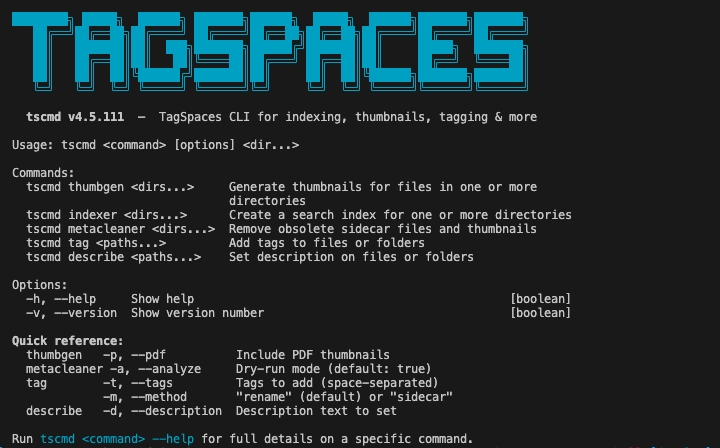
Because every command is non-interactive and produces structured output, tscmd integrates naturally into automation scripts, CI/CD pipelines, cron jobs, and AI agentic workflows where an LLM-based agent needs to organize, annotate, or prepare file collections programmatically.
The source code is available on GitHub.
Installation
npm install -g @tagspaces/shell
This makes the tscmd command available globally.
Commands Overview
| Command | Description |
|---|---|
tscmd tag | Add tags to files and folders |
tscmd describe | Set descriptions on files and folders |
tscmd indexer | Generate a search index for a folder |
tscmd search | Query an existing index for matching files |
tscmd thumbgen | Generate thumbnails for a folder |
tscmd metacleaner | Remove orphaned sidecar files and thumbnails |
All commands that take a directory argument accept multiple directories in a single invocation — for example tscmd indexer /path/a /path/b /path/c.
Tagging Files and Folders
Add one or more tags to files or folders:
tscmd tag /path/to/file.pdf -t invoice 2026 important
Tag multiple files at once:
tscmd tag /path/to/photo1.jpg /path/to/photo2.jpg -t vacation berlin
Options
| Option | Description |
|---|---|
-t, --tags (required) | Space-separated list of tags to add |
-m, --method | Tagging method: rename (default) or sidecar |
The rename method embeds tags directly in the filename (e.g. report[invoice 2026].pdf). The sidecar method writes tags to a .ts/filename.json metadata file, leaving the original filename untouched. For folders, the sidecar method is always used regardless of the --method flag.
Tags are merged with any existing tags — duplicates are automatically avoided.
Use the sidecar method when filenames must remain stable, for example in version-controlled repositories or when other tools depend on exact filenames.
Setting Descriptions
Add a text description to a file or folder:
tscmd describe /path/to/file.pdf -d "Q1 financial report, reviewed by legal team"
Read the description from a file:
tscmd describe /path/to/photo.jpg -f /path/to/description.md
Read from stdin (useful for piping output from other tools):
echo "Generated summary" | tscmd describe /path/to/file.pdf -d -
Apply the same description to multiple entries:
tscmd describe /path/to/folder1 /path/to/folder2 -d "Archive - do not modify"
Options
| Option | Description |
|---|---|
-d, --description | Inline description text. Use - to read from stdin. |
-f, --file | Path to a file whose content will be used as the description |
Descriptions are stored in .ts/ sidecar files and are visible in the TagSpaces properties panel.
Search Index Generation
Create a search index for a folder and all its subfolders:
tscmd indexer /path/to/folder/
By default the index stores file and folder metadata only (tags, descriptions, sizes, timestamps). To also extract textual content from files for full-text search, add --fulltext:
tscmd indexer --fulltext /path/to/folder/
The extracted content covers plain text (.txt, .md, .marp), HTML (.htm, .html, .xhtml, .shtml, .mhtml), email (.eml), web shortcuts (.url, .website, .webloc, .desktop), tabular/contacts (.csv, .vcf), documents (.pdf, .docx, .odt), spreadsheets (.xlsx, .ods), presentations (.pptx, .odp), and ebooks (.epub).
Index multiple folders in one call:
tscmd indexer /path/to/folder1 /path/to/folder2
Options
| Option | Description |
|---|---|
-f, --fulltext | Extract full-text content from files |
-l, --links | Also extract outbound links from file content (requires --fulltext) |
--force | Force a full re-index (skip incremental; rebuilds from scratch) |
Incremental indexing
Running tscmd indexer a second time on the same folder only re-processes files whose size or modification time changed, and prunes entries for files that were deleted. The command prints a summary line like:
incremental: +3 ~1 -2 =1247
…meaning 3 files were added, 1 modified, 2 removed, and 1247 kept unchanged. Use --force to bypass the incremental path and rebuild everything.
After each run the CLI prints counts (files, folders, total size), full-text stats (files with text, token count) when --fulltext was used, and the elapsed time.
Output files
The index is split into two files inside .ts/:
| File | Content |
|---|---|
tsi.json | Metadata index — tags, sizes, timestamps, descriptions |
tsft.jsonl | Full-text content (one JSON object per line), only when -f used |
Splitting the content keeps tsi.json small for fast loads, and lets the full-text file be streamed or partially re-read. Both files are used transparently by TagSpaces Desktop and Web.
Searching the Index
Query an existing index:
tscmd search /path/to/folder -q "quarterly report"
The search command reads .ts/tsi.json (and .ts/tsft.jsonl when the query contains free-text terms) and prints matching entries. It does not touch the filesystem beyond reading these index files, so it is fast and safe to run repeatedly.
Query syntax
The -q string mixes free-text terms with tag prefixes:
- Bare words — matched against filename, path, description, and extracted full-text
+tag— entry must carry this tag (AND)-tag— entry must not carry this tag (NOT)|tag— entry carries at least one of these tags (OR)
Example combining all four:
tscmd search /documents -q "invoice +finance -draft |urgent"
Options
| Option | Description |
|---|---|
-q, --query | Query string (see syntax above) |
-t, --tags | Additional tags to match (AND logic, merged with +tag from -q) |
--type | File-type group: any, images, documents, notes, audio, video, archives, bookmarks, ebooks, emails, folders, files, untagged |
-s, --search-type | Match accuracy: fuzzy (default), semistrict, or strict |
-n, --max-results | Maximum number of results (default: 100) |
Narrow results to images tagged vacation but not private:
tscmd search /photos --type images -q "+vacation -private"
Strict substring search with no fuzzy matching:
tscmd search /notes -q "API key" -s strict
Thumbnail Generation
Recursively generate thumbnails for all supported files in a folder:
tscmd thumbgen /path/to/folder/
To include PDF thumbnail generation, add the -p flag:
tscmd thumbgen -p /path/to/folder/
Thumbnails are stored in the .ts/ subdirectory alongside the source files.
Cleaning Obsolete Metadata
Identify orphaned sidecar files and thumbnails that are no longer connected to existing files:
tscmd metacleaner /path/to/folder/
By default, this runs in analyze mode — it lists files that would be deleted without actually removing them. Review the output, then run with --analyze false to perform the actual cleanup:
tscmd metacleaner --analyze false /path/to/folder/
Options
| Option | Description |
|---|---|
-a, --analyze | Dry-run mode (default: true). Set to false to delete files. |
Use in AI Agentic Workflows
The non-interactive, composable design of tscmd makes it well-suited for AI agent tool-use scenarios. An LLM agent with shell access can use these commands to organize and annotate files as part of a larger workflow.
Example: automated file organization
An AI agent processing a folder of downloaded documents could:
# Tag files based on content analysis
tscmd tag /downloads/report-q1.pdf -t finance quarterly 2026
tscmd tag /downloads/team-photo.jpg -t team event berlin

# Add AI-generated descriptions
echo "Quarterly financial report covering Q1 2026 revenue and expenses" \
  | tscmd describe /downloads/report-q1.pdf -d -

# Generate thumbnails and a full-text search index for the organized folder
tscmd thumbgen /downloads/
tscmd indexer --fulltext /downloads/

# Later, query the index
tscmd search /downloads/ -q "quarterly +finance"
Example: batch processing with pipes
Combine tscmd with standard Unix tools for batch operations:
# Tag all PDFs in a folder
find /documents -name "*.pdf" -exec tscmd tag {} -t document pdf \;

# Apply a description from a template file to multiple folders
for dir in /projects/*/; do
  tscmd describe "$dir" -f /templates/project-description.md
done
Why tscmd works well with AI agents
- Non-interactive — no prompts or confirmations (except metacleaner's analyze-first safety)
- Idempotent tagging — running the same tag command twice does not create duplicates
- Stdin support — agents can pipe generated text directly into
tscmd describe - Batch-friendly — multiple paths can be passed in a single command
- Structured metadata — all metadata is stored as JSON in
.ts/sidecar files, readable by both TagSpaces and other tools
Metadata Storage
All metadata generated by tscmd is stored in .ts/ subdirectories:
| File | Content |
|---|---|
.ts/filename.json | Tags and description for a file |
.ts/tsm.json | Tags and description for the parent folder |
.ts/filename.jpg | Thumbnail for a file |
.ts/tsi.json | Metadata index for the folder (tags, sizes, timestamps) |
.ts/tsft.jsonl | Extracted full-text content, one JSON object per line |
These files are automatically recognized by TagSpaces Desktop and Web applications.
Third Party Tools
Community tools compatible with TagSpaces metadata:
- TSS — a command-line tool to manage files with tags, with zsh completion support.